By Emmaline, ENGL 344, Survey of American Literature II.
As an American industry subject to conform to the capitalistic incentive for profit, the music industry has found ways to appeal to collective nostalgia by reinterpreting a supposedly shared past. Digitization has prompted mass historical accessibility and recall of music. This level of attainability has uprooted traditional nostalgia centered around a loss of something no longer obtainable. With this level of accessibility to the past, individuals and cultures relationship with music has evolved.
What is nostalgia?
Nostalgia has been culturally denoted as a regressive reaction to the loss of a better time. Many who succumb to the fear of moving on, fall victim to the the market for nostalgia. Adulthood is a time of constant change and, as a way to cope with stress, many are drawn to music that evokes their childhood or their idealized past. Nostalgia is often a reactive coping mechanism for the fear of moving on.
Is Nostalgia a Culturally and therefore Capitalistically Influenced Behavior?
Culture is essentially a collection of learned behaviors and emotional responses. The acquisition of shared beliefs and social norms established in a given culture is referred to as cultural transmission. Krumhansl explained that process occurs in a “social context rather than biological,” and therefore upbringing plays a pivotal role in socialization and cultural transmission. She further explains that, “until an individual is able to select his or her own music, it is likely to reflect his or her parents choices,” (Krumhansl 2057).
The American music industry cannot be separated from capitalism, as it is an industry and therefore conforms to the capitalistic incentive to sell musical commodities for profit. The American society uses financial success is used as a proxy for a music artist’s quality and significance. Consequently, the music markets largely appeal to a collective shared culture or history. Music is generated with the intention of appealing to the market demand for the nostalgia that derives from a supposedly shared cultural past. Samuel Camerson, a Professor of Economics at the University of Bradford, UK explains how one’s association with music is very heavily socially and culturally grounded, “The explicit monetization of nostalgia therefore tends to require social network effects. Specifically that people are sharing a common bond with ‘their’ generation.” (Cameron 138). The Journal of Consumer Research reports that consumers are more likely to spend more on a product that evokes nostalgic feelings, “We wondered why nostalgia is so commonplace in marketing. One reason could be that feeling nostalgic weakens a person’s desire for money. In other words, someone might be more likely to buy something when they are feeling nostalgic,” (qtd. In Twist). In order to operate for profit, the music industry has found ways to appeal to nostalgia for a supposedly shared cultural past.
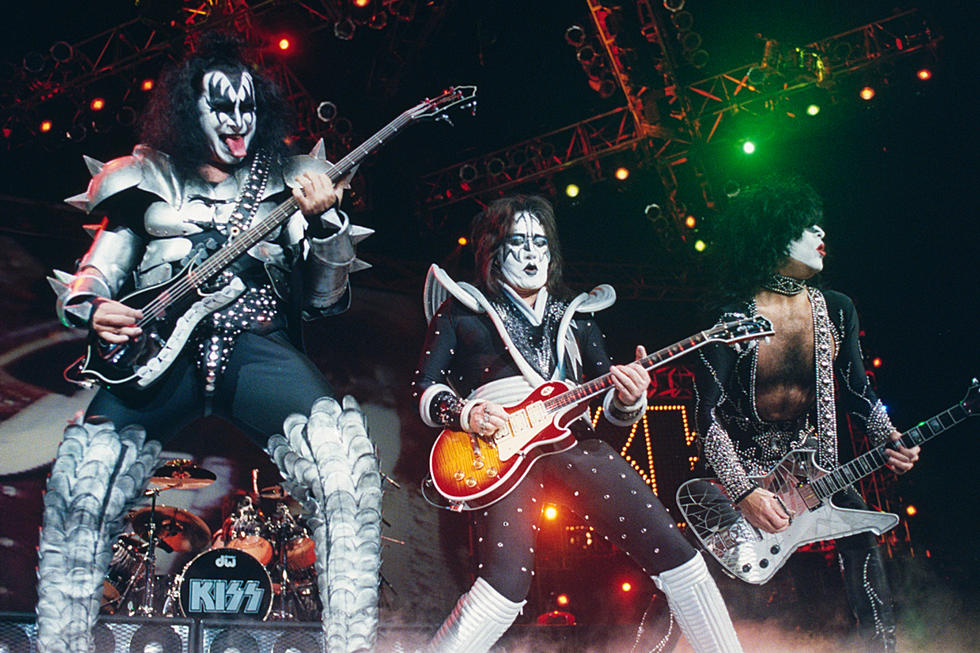
A musician or band’s absence typically precipitates success with a reunion tour or tribute act. Appealing to nostalgia has become commonplace in marketing. Major examples of musicians who have benefitted from this trend are Fleetwood Mac, who have had 14 reunion tours, and Kiss who has 142 concerts where all of their fans believed they were seeing them perform for the last time. Cameron explains that the “reliving of certain experiences which were pleasurable thereby reboot[s] this capital asset in the stock of consumption,” (Cameron 138).
Is music inherent to culture, and therefore life experience?
There is a distinguishable relationship between age and nostalgia, as well as music and self-defining memories. Claire Rathbone, from the Department of Psychology at the Oxford Brookes University, explained that self-defining memories as those that are “vivid, high in emotionality, repeated regularly, and associated with an enduring theme or unresolved conflict,” (Rathbone 1404). Music is a powerful cue for self-defining autobiographical memories, which are heavily associated with emotions. Late adolescence and early adulthood is typically the most formative time of someone’s life, “The most important period for men in forming their adult tastes were the ages 13 to 16…[women] on average, their favorite songs came out when they were 13. The most important period for women were the ages 11 to 14,” (Stephens). This is also referred to as the ‘Reminiscence bump’, which Rathbone explains to be when “Autobiographical memories are not distributed equally across the life span; instead, memories peak between ages 10 and 30,” (Rathbone 1403). Research indicates that autobiographical memories cluster around times of self image formation.
Dr. Carol Krumhansl, a professor of music at Cornell University, conducted a study using music selections taken from Billboard, an American entertainment media brand that reports the trends across all genres of music, to gather associative and memory inducing data from a diverse group of college student participants. The results indicated that not only did the participants have a higher autobiographical recall when listening to songs released during their own late adolescent years, but also to music released during their parents’ late adolescent and early adulthood years. The association that the participants had with music released during the formative years of their parents indicates the influence parents have in culturizing their children with their own generational values and knowledge and the link between music and memory evocation.
Furthermore, in 2018, Seth Stephens-Davidowitz studied how frequently every song is listened to by men and women of each age on the Spotify music platform and came to the conclusion that, “when we are grown, men and women predictably stick with the music that captured us in the earliest phase of our adolescence,” (Stephens). Due to mass digitization of music, people have accessibility to music released during their ‘reminiscence bump’ period, (late adolescence and early adulthood), and therefore an “enduring relation to the self,” (Rathbone 1404). This accessibility to the nostalgic music that triggers memories, allows people to increasingly at themselves through the lens of memory.
How does music keep the past present?
The unique circumstance of the Music Industry presently, is the mass digitization of music. With the means of digitization, music of nearly any generation of music has become accessible and a commonplace in most cultures. Georgina Barton, a Professor of Literacies and Pedagogy at the University of Southern Queensland, explains that, “music, as a common element to all cultures, can be the point of contact in determining cultural and social foundations of any given society,” (Barton). Digitization has allowed music to reach diverse consumer channels and act as a vehicle for cultural transmission. The mass accessibility to music from all generations has contorted time and memory, making the past present.
Has Western Music become detached from its present time?
Many artists are unrecognized for the music they have produced in the last 20 years. The most recent artist on most Rolling Stones ‘100 Greatest Artists’ list is Madonna. Furthermore, the Classic Hits, a radio format that includes songs from the top forty music charts, hasn’t changed much in 20 years. The music is largely Boomer centric, because it includes music that was deemed significant in the 50s, 60s and 70s. Many artists that were considered significant during the Baby Boomer period are not being recognized for the music they are producing today. For instance, Bob Dylan released some great albums after 2010, such as Tempest (2012) but he is still solely famed for some of the first albums that people deemed significant, such as his Blood on the Tracks (1975). Additionally, Bruce Springsteen is still largely famed for some of his first albums such as Darkness on the Edge of Town (1978), while he is still producing music today which is disproportionately recognized by his fans.
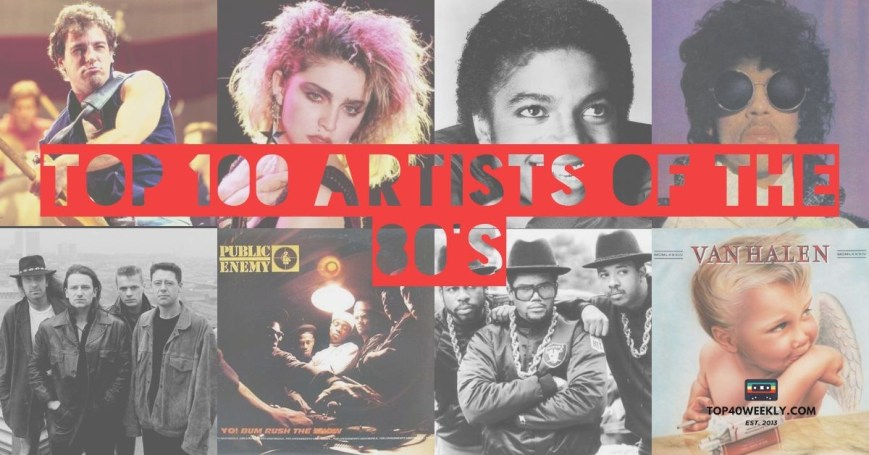
These trends of recognition indicate that the mass historical accessibility and recall of music has alleviated the sense of absence. This has therefore uprooted traditional nostalgia which is centered around a feeling of loss for something no longer obtainable. So the question now is, what is the feeling of nostalgia rooted in today?
How we remember and commemorate is much more about the present needs and social conditions than it is the past. In an interview with Johanna Blakley, who spoke in the TED Talk Does copying fashion keep it fresh, for TED Radio Hour, she commented that, “the genius is really in curating things from the past and reviving them in the present,” (Raz). Schwartz explains that, “Collective memory conceives the past as a social construction that reflects the problems and concerns of the present,” and that “…collective memory is both a mirror and a lamp- a model for and a model of society,” (Schwartz 909). In his study of the commemoration of Abraham Lincoln and the memory of World War II, Barry Schwarts from the University of Georgia determined that, “Crisis provides nations with strong incentives for invoking the past,” (Schwartz 908). Explicit memory is an intentional retrieval of the past in a way that supports a current notion that a community or culture would like to uphold, often by recontextualizing the past. Musical preference generally extends far beyond the present year of music production, which therefore suggests that music is not circumscribed by it’s time and place.
How does music take shape to the way in which society engages with it?
Music is a dynamic process that takes shape to the way in which members of a society engage, contextualize, or interpret it in a way that aligns with their own cultural values at the time. With the vehicle of music, socialization is very powerful. The music that artists create cannot be divorced from the social behaviors that produce it and the inspiration they receive from the cultures in which they participate.
Communities construct the tone when retelling the past. In his article, Social memories: Steps to a sociology of the past (1996) professor of sociology at Rutgers University, Eviatar Zerubavel, suggests that in order to situate oneself as part of a community, one most position themselves in the past. He explains that, “being social presupposes the ability to experience events that happened to groups and communities in which we belong long before we joined them as if they were part of our own past,” (qtd. In Olick & Robbins 123). Similarly, Cultural Theorist Stuart Hall, in his article Cultural Identity and Diaspora, defines what a ‘cultural identity’ entails today with consideration to the accessibility we now have to the past. He explains that, “Identities [personal or collective] are the names we give to different ways we are positioned by, and position ourselves in, the narratives of the past,” (qtd. in Olick & Robbins 121). Presently, the cultural identities and historical identities of those living in the age of the internet coincide.
Music is a form of cultural expression. In her book We Should All Be Feminists, Chimamanda Ngozi Adichie explains that, “Culture does not make people. People make the culture,” (46). Similar to this notion, Barton explains that, “Culture is an ‘empty vessel’ waiting for people to fill it with meaning,” (Barton). Therefore, culture and memory is dynamic, working differently at different points of time. People share meaning and make sense of their cultural experience through expressive form, therefore making music a symbolic representation of culture.
Simmering in Nostalgia
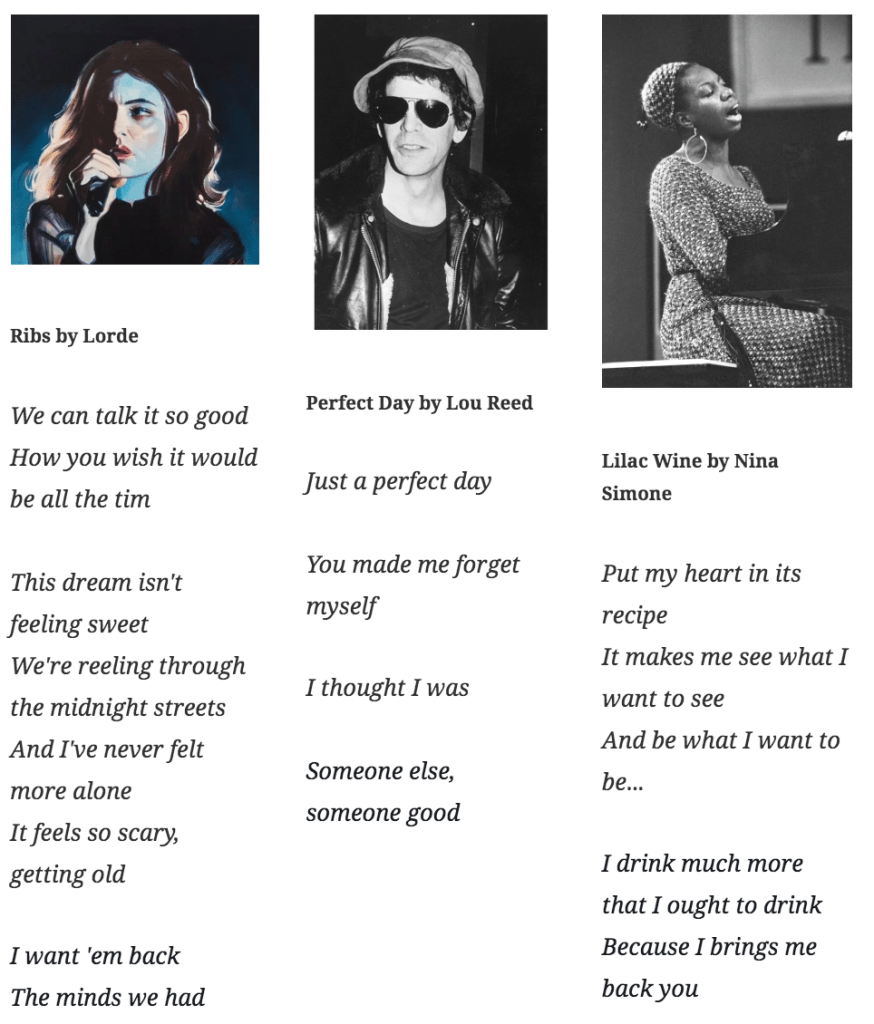
Engaging with songs that evoke memories from our idealized past feeds nostalgia. The musical trend of singing about sentimental heartbreak and a yearning for youth is currently rising in popularity. Below are some popularized examples of artists who take a ‘nostalgic trip’ in their songs in a way that the majority of their audience can relate to.
Works Cited
Barton, Georgina. “The Relationship Between Music, Culture, and Society: Meaning in Music: Implications for Classroom Practice.” Music Learning and Teaching in Culturally and Socially Diverse Contexts: Implications for Classroom Practice, Palgrave Macmillan, 2018, pp. 23–41.
Cameron, Samuel. Music in the Marketplace: a Social Economics Approach. Routledge, Taylor & Francis Group, 2015.
Krumhansl, Carol Lynne, and Justin Adam Zupnick. “Cascading Reminiscence Bumps in Popular Music.” Psychological Science, vol. 24, no. 10, 2013, pp. 2057–2068., doi:10.1177/0956797613486486.
Olick, Jeffrey K., and Joyce Robbins. “Social Memory Studies: From ‘Collective Memory’ to the Historical Sociology of Mnemonic Practices.” Annual Review of Sociology, vol. 24, no. 1, 1998, pp. 105–140., doi:10.1146/annurev.soc.24.1.105.
Rathbone, C. J., et al. “Self-Centered Memories: The Reminiscence Bump and the Self.” Memory & Cognition, vol. 36, no. 8, 2008, pp. 1403–1414., doi:10.3758/mc.36.8.1403.
Raz, Guy, and Johanna Blakley. “TED Radio Hour.” TED Radio Hour, NPR, 27 June 2014, https://www.npr.org/programs/ted-radio-hour/321797073/what-is-original.
Schwartz, Barry. “Memory as a Cultural System: Abraham Lincoln in World War II.” American Sociological Review, vol. 61, no. 5, 1996, p. 908., doi:10.2307/2096461.
Stephens-davidowitz, Seth. “The Songs That Bind.” The New York Times, The New York Times, 10 Feb. 2018.
Twist, Mary-Ann. The Nostalgia Effect: Do Consumers Spend More When Thinking about the Past?, University of Chicago Press, www.press.uchicago.edu/pressReleases/2014/July/140730_JCR_lasaleta.html.
 Poetics Presentation