The term montage is defined as the technique of assembling contrasting images into a composite whole. In film, montage has more of a conceptual meaning that extends beyond everyday perceptual observations of what is literally depicted in the clips. This is similar to poetry which uses images thematically rather than structurally.
It is important to consider Deren’s film Meshes of the Afternoon not only through a cinematic lens, but also through the lens of poetry. Following Kirby Ferguson’s TED talk, Embracing the remix (2012), Ben Lillie interviewed him regarding his notion of the relationship between creativity and influence. Ferguson explained the importance of, “how inspired the combinations are. If you’re sticking to a certain realm and you’re not really getting broad influences into what you’re doing, then I think your outcomes are going to be limited,” (qtd. in Lillie). Mark Reid from the Education Department at the British Film Institute explains that the vertical development of film, rather than “underscoring and ultimately reducing the possibilities in the poem, the film expands it into new territories,” (67).
Both poetry and the cinematic technique of the montage involve the interplay of images to make a composite whole. The motley of clips and symbols leave room for the reader to fill in with their own interpretation and association. In his essay “Montage of Cine-Attractions,” Sergei Eisenstein developed a montage theory, in which he proposed that raw footage lacks specific meaning in itself, but rather acquires meaning in its recombination with other units (Kriebel). Poetry and the Montage technique are both used to contort and condense time. “The principle of montage,” Reid explains, “is to cut between images, within and sometimes against the structure of the form you’re working with,” (63). The break or cut between images is essentially what a poet does with line and stanza breaks, and deviating from a rhyme scheme. He explains that poetry and film are co-functional for dual purposes, as both medians “connot[e] some sense of artfulness and deliberation, of implicitness and allusiveness, of excesses of scale – whether in miniature or in grand gesture – of surrounding space, of ambiguity,” (Reid 66).
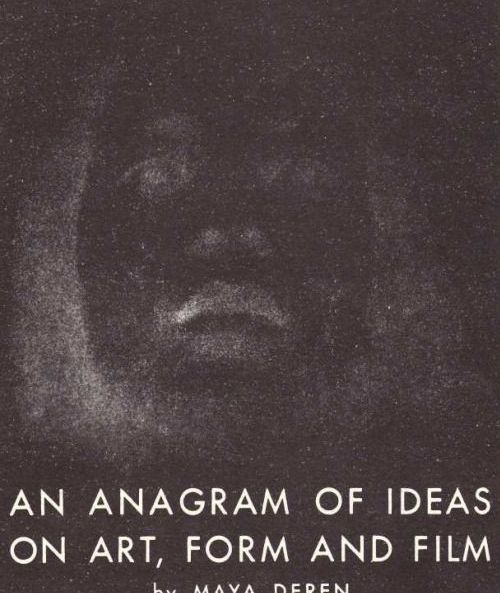
Deren put this idea into practice in her film by harnessing poetic logic in the curation of the clips by building a narrative that moved from one rhetorical point to another. She explained in a lecture she gave about her film in 1951 that, “the meaning of a work of art rests not in elements which appear in it, but in the relationship of those elements,” (qtd. in Ieropoulos). Deren also explained in section three of her book titled An Anagram of Ideas on Art, Poetry and Film that, “to generalize from a specific image is not the same as to understand it as a symbol for that general concept,” (Deren 27). The clips in her film, released three years prior to her Anagram book, were emotionally linked together rather than strung into a linear narrative. Poetry follows very similar logic to that of that emotional storytelling of a montage of clips, as poetry by nature is full of abstractions, largely appeals to senses and is not grounded in a storyline.
 Poetics Presentation