What distinguishes anything from what we decide to call poetry? “Poetic” as a descriptor remains fairly shapeless when used in connection with cinema, as it has been used to refer to a large number of films. In a “Poetry and the film” symposium in 1953 where she conversed with Parker Tyler, Dylan Thomas, and Arthur Miller and William Maas as the chairman, she explained that poetry can be understood as “creat[ing] visible or auditory forms for something which is invisible, which is the feeling, or the emotion, or the metaphysical content of the movement [and] consist[ing] not of assonance; or rhythm, or rhyme, or any of these other qualities which we associate as being characteristic of poetry [but rather] is an approach to experience,” (qtd. in Maas). Scott Macdonald, a professor of cinema at Hamilton College, published an article concerning the relationship of poetry and independent film, where he also agrees with poetry being an approach to experience. He explains that cinema, when used in conjunction with poetic techniques, can serve as a medium for expressing human sensibility (MacDonald 6). Poetry, as an expression of human sensibility, is versatile to different art forms that transcend the implication that materials impose on expression.
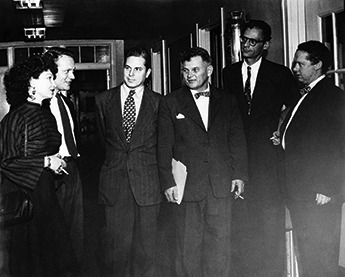
right: Dylan Thomas, Arthur Miller, Willard Maas, Parker Tyler, Amos Vogel, and
Maya Deren. Courtesy of Amos Vogel.
Poetry is the only form of which Deren credits borrowing some similar creative techniques from in the creation of her film Meshes of the Afternoon. After all, her background was in literature, not film. She had a bachelors in literature from New York University and a Masters in literature from Smith College, with an emphasis in poetry. There are distinguishable similarities between her filming tactics and modern poetic techniques. Meshes of the Afternoon is considered poetic in its construction, as it employed poetic logic and heavily harnessed symbology in the images which rested heavily on the individual’s association, therefore hitting many of the facets of poetry.
 Poetics Presentation